


MIG Welding Tutorial

The MIG welding tutorial (the pages below) covers the steps you'll need to take to learn how to MIG weld. It's the sort of thing you'd find in a welding for dummies or welding secrets book, but this one is free and includes videos. It's not a complete alternative to one to one tuition - see the college course page to find a course.

Welding safety

Welding Safety

Find out some of the ways welding can damage your health or kill you, and how you can protect yourself.

Installing and tensioning MIG wire

Installing the wire

Wire feed is the most common cause of MIG welding problems. A few tips on how to install the wire and tension the wire feed.

Power and wire speed calculator

Power and wire speed calculator

A tool to help you estimate initial power settings for your welder. Further pages in the tutorial will help fine tune the settings for that perfect weld.

Positioning the torch and laying welds

Torch position and laying welds

Prepping for welding, positioning the torch, and making some practice welds.

Setting wire speed

Setting the wire speed

MIG welders are sensitive to wire speed. There is a very narrow wire speed range where the welder welds nicely between burn back and stuttering. This page should help you fine tune the wire speed for your welder.

Fine tuning power settings

Finding the right power setting

The choice of power setting will vary from welder to welder, and can be influenced by technique. The best way to find the appropriate power setting for your welder is to experiment on scrap metal then examine the welds

Butt welding

Butt welding

It's best to develop neatness and technique before attempting to join two pieces of metal together. It's a tricky first weld, so easier overlap welds are touched upon too.


MIG Welding Techniques

Welding thin metal

Thin Metal

Blowing holes in thin metal? But don't want to buy a TIG? Here's a technique that should be good for 0.6mm sheet.

Gasless weld

Gasless MIG Welding

You can use it in the wind. A page with pros, cons and techniques.

plug weld

Plug weld

Plug welding is a DIY alternative to spot welding. It's a useful technique in automotive repairs where the panels were originally spot welded.

Finishing Welds

Finishing Welds

There's only one way to end up with the invisible welded repair and it doesn't involve your ordinary angle grinding disc. This one is a real welding secret.

90 amp welder

Welding thick metal

Manufacturers claims of welder capability often seem exaggerated. The Clarke 90EN claims to be capable of welding 4mm steel sheet, but the calculator says 2mm. The page looks into the techniques required to achieve the claimed thickness.

tips and troubleshooting

Tips and tricks

A few random thoughts and techniques that haven't found a home elsewhere in the tutorial.


Welding other metals with a MIG welder

Set up for aluminium welding

Setting Up for Alu Welding

Aluminium welding can be frustrating until you de-bug your welder. The wire is much less stiff than steel wire so is prone to crumple after the roller. An oversized tip and plastic wire liner are required together with other tweaks to your welder.
MIG welding aluminium

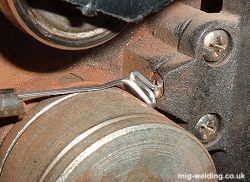
Aluminium Welding

How to weld aluminium (turns out it's not so bad).

Aluminium very quickly forms an oxide layer which needs to be removed before welding. From there the welding process is tricky because of the rather narrow window between melting the aluminium and blowing holes.
MIG Brazing

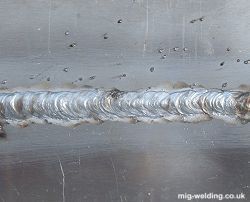
MIG Brazing

MIG brazing is a relatively new technique that tends to be used by automotive manufacturers on modern steels that can't really be welded using conventional techniques.

The material is intended to be used with specially developed MIG welders, though it can be carried out with a standard MIG with some loss of benefit. The page suggests a technique and includes a strength test.
Cast iron

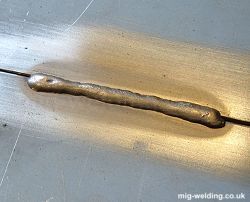
Cast Iron MIG Welding

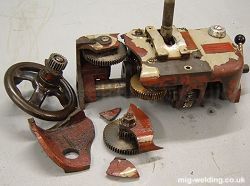
A very useful application of MIG brazing wire is in the repair of cast iron. Braze is much softer than steel filler wire so reduces problems with cracking of the cast iron.

This page describes a traditional studding technique as well as the use of braze to join a cast iron gear casing, and discusses alternative methods that could have been used to join the casting.

Postscript

We Learn…
10%…of What We Read
20%…of What We Hear
30%…of What We See
50%…of What We See and Hear
70%…of What We Discuss With Others
80%…of What We Experience Personally
95%…of What We Teach Others
–William Glasser

The quote to the left relates to learning in general, but it seems especially appropriate for MIG welding.

A college course or one to tuition is the easiest way to learn mig welding, but a little interaction on the welding forum can be helpful. I've learned a lot from trying to answer other people's questions and realising I didn't really know the answer myself.

Feedback - for any information you would like to add or for reporting incorrect information.